
Jirang
— The Mini Tibet of Odisha
Chandragiri · Gajapati District · Odisha
You don't expect Tibet in Odisha. And yet, tucked into the forested hills of Gajapati district, about 87 kilometres from Berhampur, there is a place where saffron-robed monks walk in silence, colourful prayer flags flutter in the mountain breeze, and the deep resonance of monastery bells echoes across a valley that feels — improbably, unmistakably — like somewhere else entirely. This is Jirang, also known as Chandragiri, and the people who live here call it Phuntsokling: the Land of Happiness and Plenty.
Jirang's story is one of the most quietly remarkable in eastern India. It is a story of exile and resilience, of a community that lost its homeland and, in a green valley in southern Odisha, built something that kept its culture, its faith, and its identity alive. The Padmasambhava Mahavihar — the five-storeyed Tibetan Buddhist monastery that rises above the settlement — is the visible symbol of that endurance. One of the largest Buddhist monasteries in eastern India, it was inaugurated by the Dalai Lama in 2010 and draws visitors from across the country who come to experience its architecture, its spirituality, and its profound calm.
Jirang is not a loud destination. It asks you to slow down, to observe, to sit still in a place where silence has texture. And if you let it, it will give you something rare: the feeling of having truly arrived somewhere different.
What Makes It Special
When Tibetan refugees first settled in Chandragiri in 1963, they gave the land a name that captured both their hope and their gratitude — Phuntsokling. In the decades since, the community has farmed maize, built temples, raised children, educated monks, and preserved a culture that the world once feared was lost. The name has proven prophetic.
Your Jirang Journey, Step by Step
A Community Born from Exile
In 1959, China occupied Tibet. Within months, the Dalai Lama and tens of thousands of Tibetans crossed the Himalayas into India, beginning one of the great refugee migrations of the twentieth century. The Indian government, under Nehru, accepted them — and over the following years, established a series of settlements across the country to give the displaced community land and livelihood.
In 1963, the Government of Odisha offered land at Chandragiri, in the forested hills of Gajapati district, to a group of Tibetan settlers. What they found was jungle, rolling terrain, and silence. What they built, over the next six decades, was a functioning community: farms, schools, temples, markets, and a monastery that would one day stand 70 feet tall and educate 200 monks. Chandragiri became one of just six main Tibetan settlements in all of India — and the only one in Odisha.
Today, the settlement's roughly 5,000 Tibetan residents grow maize — so much of it that Chandragiri and its surroundings are known as the Maize Bowl of Odisha. Their children go to Tibetan schools. Their elders speak Tibetan. And their monks study Buddhist philosophy in a monastery built to look as though it belongs in Lhasa. The homeland is far away, but Phuntsokling — the Land of Happiness and Plenty — is unmistakably real.
Padmasambhava Mahavihar — The Heart of Jirang
The Padmasambhava Mahavihar — also known as Thupten Mindolling Monastery — is named after Guru Padmasambhava, the 8th-century Indian master who brought Buddhism to Tibet. The monastery was conceived as a centre for preserving Tibetan Buddhist teaching and culture, a living institution rather than simply a place of worship. The Dalai Lama gave his blessing for the project in 1998, the foundation stone was laid in 2003, and construction was completed in 2008 at a cost of approximately ₹8 crores. In January 2010, the Dalai Lama returned to inaugurate it.
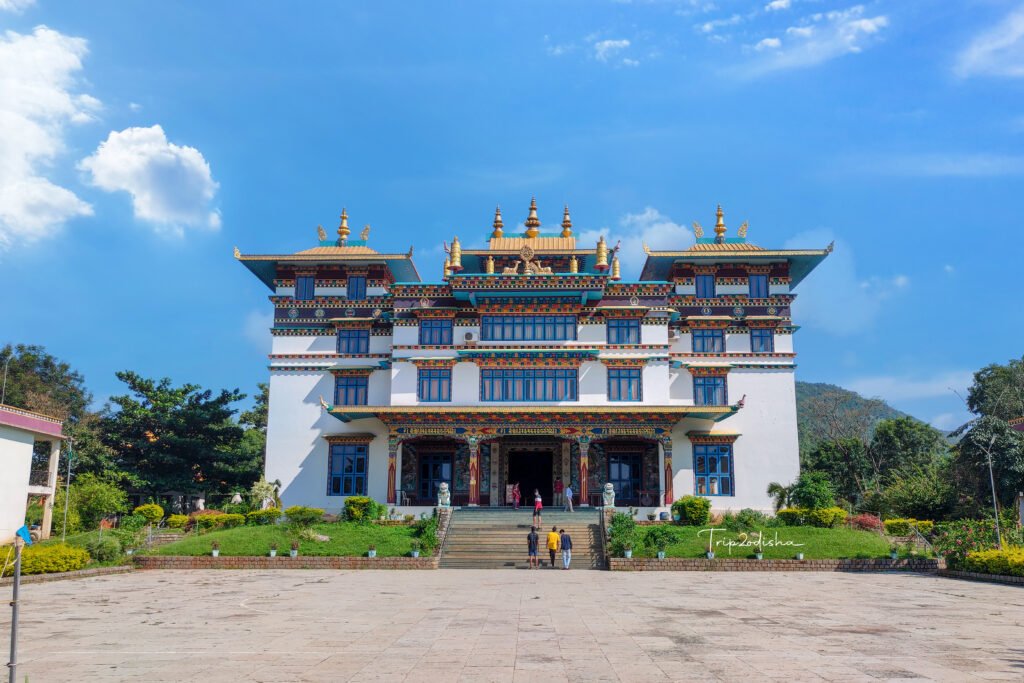
The monastery stands five storeys tall — approximately 70 feet — and was built with the help of craftsmen from Tibet, Nepal, and Bhutan. Every detail of its construction follows traditional Tibetan Buddhist principles: the rich reds and golds, the intricate painted motifs, the carved wooden eaves, the gilded rooftop spires. Inside, a 23-foot statue of Lord Buddha and a 17-foot statue of Guru Padmasambhava dominate the main prayer hall — though photographs are no longer permitted inside, and visitors are requested to leave cameras and phones at the entrance.
The monastery is both a place of pilgrimage and a working institution. Nearly 200 monks live and study here, following a rigorous curriculum that blends Buddhist philosophy, meditation, yoga, and ritual practice. The monastery also maintains a medicinal plant garden, and the complex includes hostels, teaching halls, and smaller shrines dedicated to various aspects of the Tibetan Buddhist tradition.
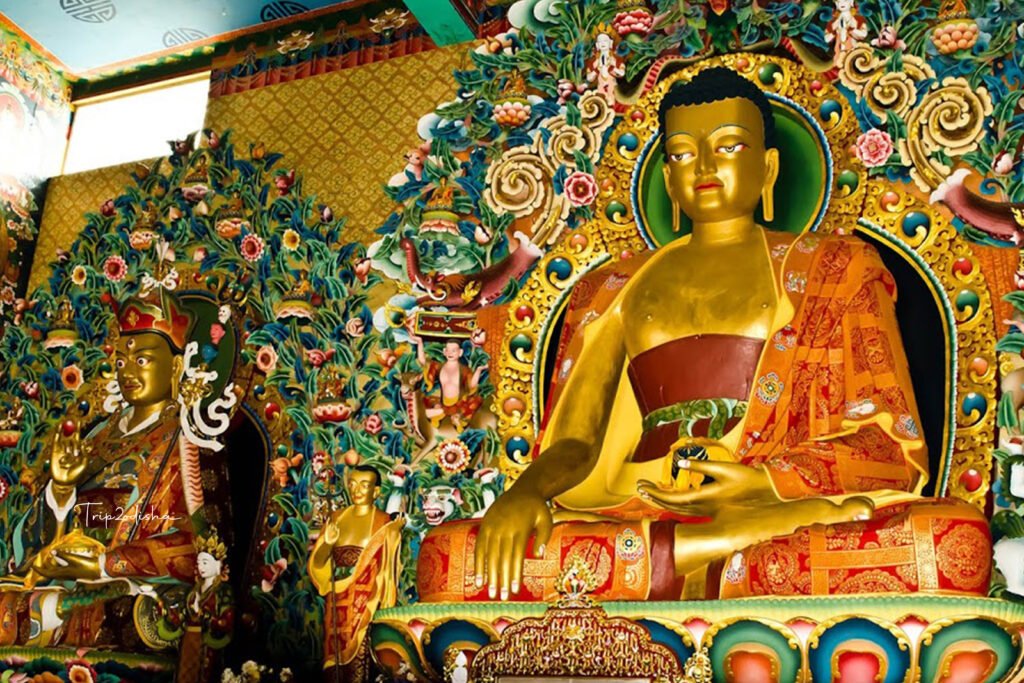
Visitor note: Cameras and mobile phones are not permitted inside the monastery prayer halls. Remove shoes before entering. Modest, respectful clothing is expected. The monastery is open from 6 AM to 8 PM daily.
Prayer Wheels & Flags — The Language of the Wind
Two of the most visible and moving elements of Tibetan Buddhist practice surround the Jirang monastery, and both are worth understanding before you encounter them. The first are the Prayer Wheels — cylindrical metal drums mounted on spindles, set into the walls around the monastery complex. Inside each one are sacred mantras and prayers, densely rolled and inscribed. In Tibetan Buddhist belief, spinning a prayer wheel clockwise is considered equivalent to reciting those prayers aloud — a single revolution sending thousands of mantras outward into the world.
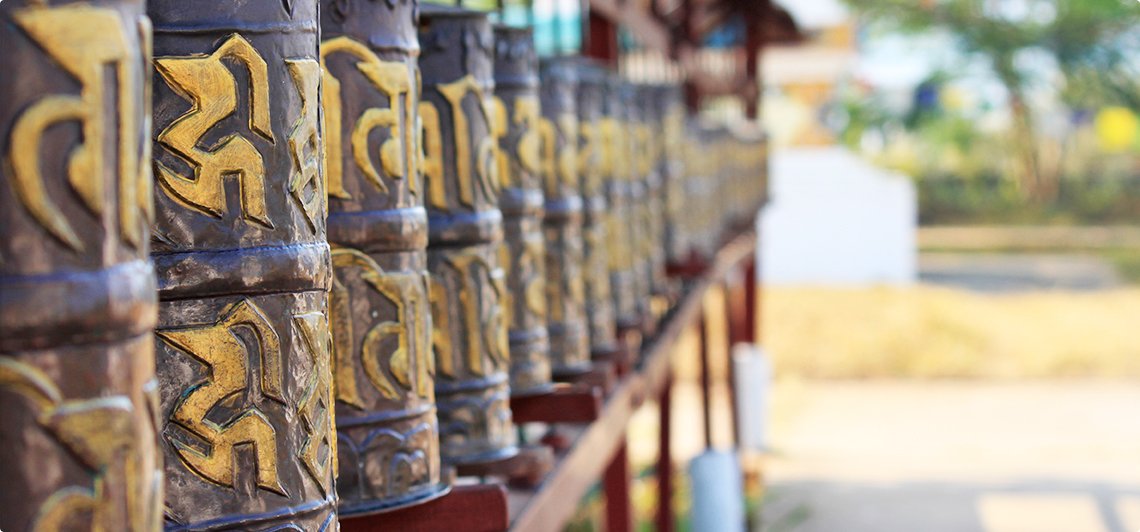
Walk the perimeter of the monastery and spin each wheel as you pass — this is not tourism but participation. There is something deeply calming about the rhythm of it: the weight of the wheel, the soft metallic sound, the sense of continuity with the monks and pilgrims who have done the same thing every day for years.
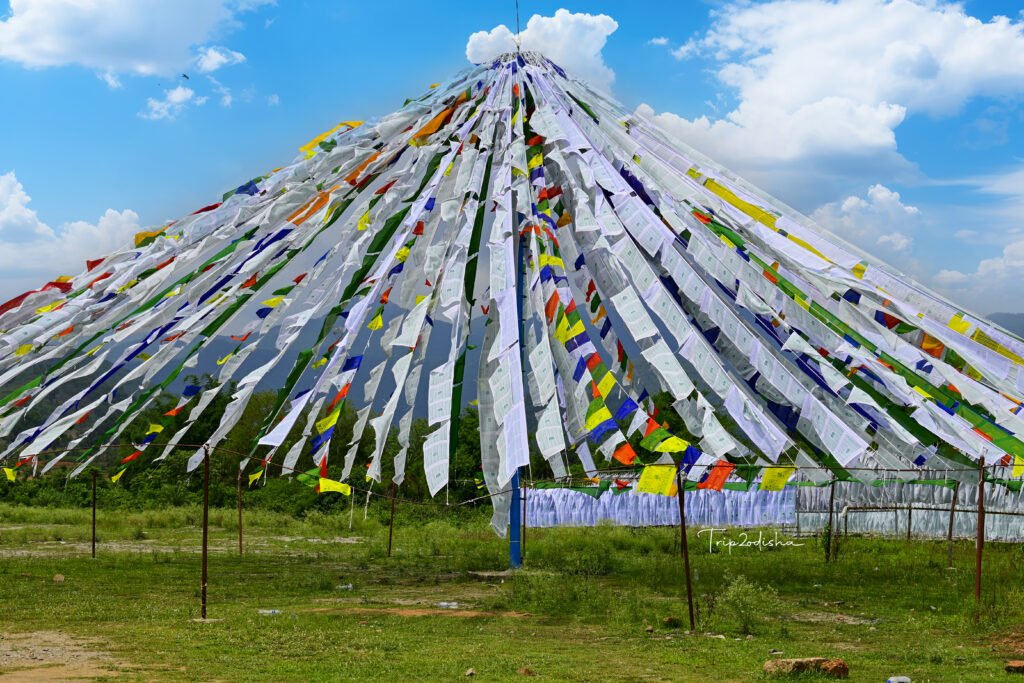
Equally striking are the Prayer Flags that drape across the monastery compound in long diagonal strands, snapping and rippling in the breeze. The flags come in five colours, each representing one of the five elements: blue for sky, white for air, red for fire, green for water, and yellow for earth. Each flag is printed with mantras and sacred images. Tibetan tradition holds that as the wind moves through the flags, it carries those prayers outward — blessing everything the wind touches.
Khasada Waterfall — Nature's Waterslide
About 5–6 kilometres from the Jirang monastery, down a road that winds through thick forest, lies Khasada Waterfall — one of the most naturally playful waterfalls in southern Odisha. The name itself is telling: khasada in Odia means "to slip," and the waterfall earns it completely. Rather than dropping in a single plunge, the water runs down a long slope of smooth, curved rock — a natural waterslide that visitors have been sitting on and sliding down for as long as anyone can remember.
The waterfall drops approximately 50 feet overall, forming a pool at the base where the water collects in a clear, cool swirl. Two small temples stand near the waterfall — one dedicated to Lord Mahadev, one to Lord Shriram — adding a quiet spiritual dimension to an otherwise purely joyful place. Families come here for picnics, young travellers come to wade, and photographers come for the light that filters through the trees and catches the water in ways that make it look lit from within.
Best time: Monsoon and early winter (July–January) when water flow is at its peak. The rocks can be slippery — footwear with grip is recommended. Don't leave the monastery visit too late, or darkness will cut the waterfall visit short.
Moon Hills Homestay & Mr. Dhana
About 4–5 kilometres from the monastery, Moon Hills Homestay offers the kind of accommodation that makes a journey complete. The property sits in the middle of nature — surrounded by fruit trees, flowering plants, and the unhurried rhythms of the countryside. For those who want something beyond a standard room, the homestay has three mud cottages (kuchcha-style, with all modern amenities) that give you the feeling of sleeping inside the landscape itself.
The food here is homestyle and genuinely delicious — fresh, simple, and made with the kind of attention that restaurants rarely manage. But the real discovery at Moon Hills is its caretaker and resident artist, Mr. Dhana. Quietly going about his work, Mr. Dhana is responsible for everything beautiful about the property that is not natural: the intricate Radha-Krishna sculpture in the courtyard, the paintings on the dining room walls, the arrangements that make every corner of the property feel considered and alive. When we left, he sent us off with jackfruit and papaya from the garden — a gesture so generous it felt like a benediction.
Things To Do in Jirang
Festivals & Special Occasions
See the Full Jirang Journey
Join us as we travel from the hot springs of Taptapani to the monastery at Jirang — prayer wheels, prayer flags, Khasada Waterfall and all.
Best Time to Visit
What You'll Find Here
How to Reach Jirang
What Jirang Leaves You With
I came to Jirang expecting a monastery. What I found was a story — one of loss and adaptation, of faith carried across mountains, of a community that refused to let its culture dissolve into exile. The Padmasambhava Mahavihar is extraordinary not just because of its size or its architecture, but because of what it represents: an act of collective will, sustained over decades, in a valley far from home.
But Jirang is also simply beautiful. The prayer flags in the wind, the sound of the wheels spinning, the cool air over Khasada Waterfall, the warmth of a meal cooked in someone's home, the quiet genius of Mr. Dhana working in the garden. These are not things you photograph — they are things you carry with you, arriving back into ordinary life with the faint sense that you have been briefly, unexpectedly, in a place where something important is being kept alive.
If you pass this way — on any road through southern Odisha — stop at Jirang. Let the bells ring. Spin the wheels. Watch the flags. And let the Land of Happiness and Plenty offer you, for a little while, exactly what its name promises.
May the prayers of the flags reach you. May the wheels keep turning. May every journey you take carry you somewhere that changes you for the better.
Thank you for travelling with us — until the next destination.